XIAMEN OLINK IMPORT & EXPORT CO.,LTD
Specially Develops, Produces and sells connectors / Terminals / wire harness / switches.


-
Give us a call 0592 6536915
-
Email us sophia@fzolink.com
Every electrical network—whether it powers an automated robotics cell, an electric vehicle drivetrain, or a utility-scale energy storage rack—depends on the metallurgical integrity of its wire terminations. When joining a copper conductor to a metal contact or terminal, engineers primarily choose between two foundational methods: mechanical crimping and thermal soldering. While both techniques are capable of establishing low-resistance electrical continuity, they behave in radically different ways when subjected to real-world industrial stresses.
A termination method that works flawlessly inside a static desktop computer can suffer catastrophic fatigue failure within weeks on a vibrating factory floor or inside a heavy-duty vehicle chassis. Understanding the physics of cold-welding, solder wicking, thermal conductivity, and quality control is essential for system architects. This engineering guide compares crimping and soldering across critical industrial performance metrics to help you specify the most reliable termination standard for your equipment.
Soldering joins metals by melting a filler alloy (typically tin-silver-copper in RoHS-compliant lead-free formulations) at temperatures between 217°C and 250°C. The molten solder flows around the copper strands and forms an intermetallic bond upon cooling. While this creates a continuous electrical path, the electrical conductivity of standard solder alloy is only about 10% to 15% that of pure copper. Furthermore, soldering relies heavily on chemical flux to clean surface oxides; if flux residue is not thoroughly removed, it can absorb atmospheric moisture and trigger long-term electrochemical corrosion.
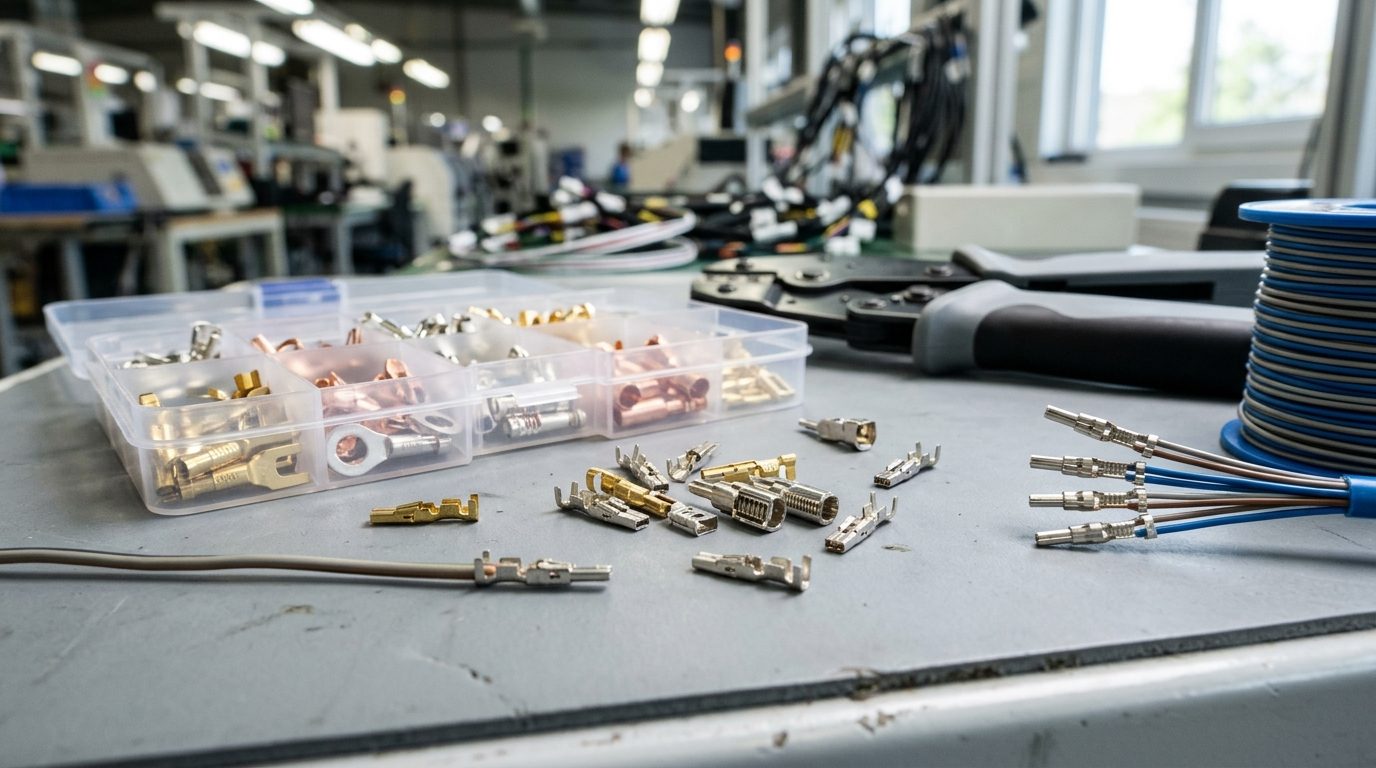
Crimping, by contrast, is a purely mechanical, heat-free process. When a calibrated die compresses precision-engineered industrial crimp terminals around stripped copper strands, the immense pressure shears away surface oxide films and plastically deforms both the terminal barrel and the individual wire strands. Under a microscope, the round copper strands deform into tightly packed hexagonal shapes with zero air voids between them. This phenomenon—known as a gas-tight connection—creates a direct copper-to-metal cold weld that physically blocks oxygen, humidity, and corrosive industrial gases from ever reaching the contact interface.
In aerospace, automotive, and industrial automation, mechanical vibration is the primary cause of wire breakage. Stranded copper wire is specifically engineered to flex repeatedly without fracturing. However, when molten solder is applied to a stranded wire, capillary action draws the liquid metal up underneath the wire's insulation jacket—a defect known as solder wicking.
Once cooled, the wicked solder fuses the flexible strands into a stiff, brittle solid rod. The exact point where the rigid solder stops and the flexible copper strands begin becomes a severe mechanical stress concentrator. Under continuous harmonic vibration, every micro-flex concentrates right at this boundary, causing the individual copper strands to work-harden and snap one by one until the circuit opens completely.
Crimped terminations eliminate this failure mode through a two-stage mechanical design: the conductor crimp secures the bare copper strands for electrical continuity, while the rear insulation crimp clamps directly onto the outer polymer jacket of the wire. This secondary clamp absorbs all mechanical pulling, bending, and vibration forces before they can ever reach the delicate copper conductor.
In high-power distribution systems—such as servo motor drives, solar inverters, and battery energy storage banks—terminations must survive transient current spikes and elevated ambient temperatures. Soldering introduces a major thermal vulnerability: if a temporary short circuit or overload heats a high-current joint above 217°C, the solder alloy begins to soften and reflow. Under mechanical tension, the wire can literally pull free from the molten joint, creating an exposed live conductor and a severe arc-flash fire hazard.
Because a mechanical crimp relies on the structural yield strength of copper and brass rather than a low-melting-point filler alloy, it remains mechanically locked even under extreme thermal stress. This is why international safety standards strictly mandate heavy-duty mechanical crimping for high-amperage industrial power interconnects, ensuring uninterrupted structural stability even during transient thermal overloads.
From a manufacturing scalability perspective, manual soldering is heavily dependent on operator skill. Factors such as iron tip temperature, dwell time, and solder volume vary from technician to technician, frequently resulting in hidden defects like "cold solder joints" that pass initial visual inspection but fail in the field.
In contrast, industrial crimping is engineered for 100% statistical repeatability. When producing automated factory-tested wire harness assemblies, servo-driven crimping presses utilize real-time Crimp Force Monitoring (CFM) sensors. Every single crimp stroke is measured against a master force curve; if a single copper strand is missing or the insulation is slightly misaligned, the machine instantly flags and rejects the part. Combined with destructive pull-force testing and microscopic cross-section audits governed by IPC/WHMA-A-620, crimping guarantees zero-defect reliability across millions of terminations.
| Performance Metric | Mechanical Crimping | Thermal Soldering |
|---|---|---|
| Vibration Resistance | Exceptional; dual-stage insulation crimp absorbs mechanical strain. | Poor; solder wicking creates a brittle fracture point under flexing. |
| Corrosion Protection | Gas-tight cold weld blocks oxygen and moisture internally. | Vulnerable to flux residue corrosion if not thoroughly cleaned. |
| High-Temperature Limit | High; limited only by the base copper alloy and wire insulation. | Low; solder softens and reflows above 183°C–217°C during overloads. |
| Production Scalability | High-speed automation with real-time Crimp Force Monitoring (CFM). | Slow for wire-to-terminal joints; high risk of operator variability. |
| Best-Fit Applications | Industrial machinery, EV powertrains, solar farms, robotics. | Static PCBs, micro-electronics, lab prototypes, field repairs. |
Crimping is preferred because soldering creates a rigid transition zone where molten solder wicks up the copper wire strands. Under continuous mechanical vibration, this brittle boundary acts as a stress concentrator that quickly causes wire fatigue and snapping. Properly crimped terminals maintain strand flexibility and include an insulation crimp for mechanical strain relief.
A gas-tight crimp occurs when a calibrated crimping die compresses a metal terminal barrel and copper wire strands under high pressure, causing cold-welding deformation. This eliminates all microscopic air voids between the metals, preventing atmospheric oxygen and moisture from entering the joint and causing internal oxidation.
Soldering remains ideal for static printed circuit board (PCB) assemblies, ultra-miniature low-current signal contacts, rapid laboratory prototyping, and field repairs where specialized calibrated crimping dies are unavailable.
Achieving zero-defect electrical reliability requires precision tooling, verified metallurgy, and strict adherence to international termination standards. At Xiamen Olink, we manufacture high-conductivity industrial terminals, high-current connectors, and automated, pull-force-tested wire harnesses engineered to survive relentless vibration and thermal stress. Contact our engineering team today to optimize the termination architecture of your next industrial project.
Tel : 0592 6536915
Mobile : 8613950494073
Email : sophia@fzolink.com
Skype : Zheng lris
Whatsapp : 8613950494073