XIAMEN OLINK IMPORT & EXPORT CO.,LTD
Specially Develops, Produces and sells connectors / Terminals / wire harness / switches.


-
Give us a call 0592 6536915
-
Email us sophia@fzolink.com
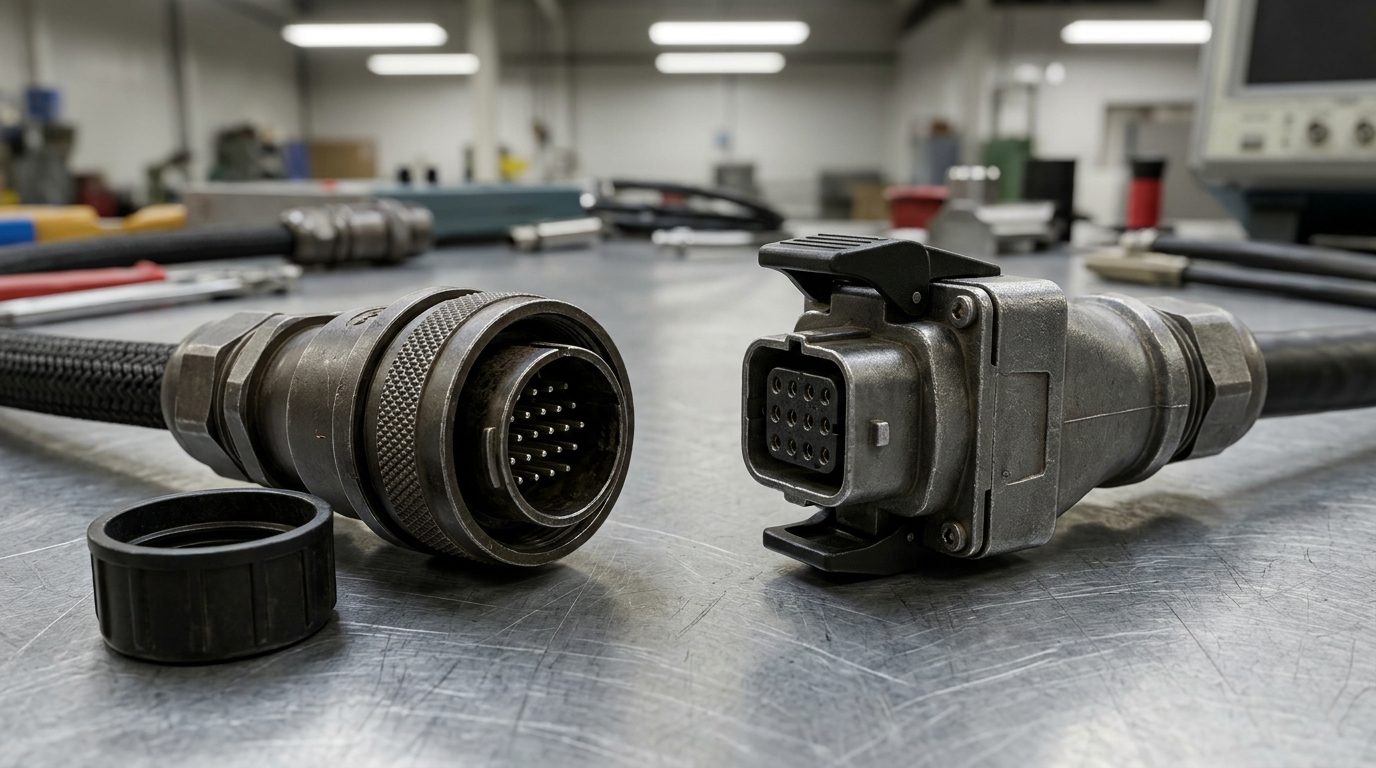
In the vast ecosystem of industrial electrical components, engineers face a critical decision when designing wire-to-wire or wire-to-board interfaces: should they specify a circular connector or a traditional rectangular connector? While both form factors are capable of transmitting power, data, and signal, their physical geometry dictates entirely different mechanical behaviors under stress. A connector's shape influences how it handles mechanical vibration, how effectively it seals out moisture, and how efficiently it utilizes space in cramped machinery.
Choosing the wrong connector profile can lead to premature ingress failures, compromised shielding, or inefficient cable routing. This comprehensive technical guide analyzes the fundamental engineering differences between circular and traditional rectangular connectors, helping system architects select the optimal interface for their harsh-environment applications.
The most profound difference between the two styles lies in pure physics. A circular connector utilizes a cylindrical housing. Geometrically, a cylinder is exceptionally strong because it lacks edges or corners where mechanical stress typically concentrates. If a heavy tool is dropped on a circular metal connector on a factory floor, the impact force is distributed evenly across the curved surface, minimizing the risk of a housing fracture.
In contrast, traditional rectangular connectors have distinct corners. When subjected to physical impact or torsional strain (twisting), these corners become stress concentrators. Over time, heavy impacts can cause the corners of a rectangular housing to crack, compromising the internal pins. For applications exposed to constant mechanical abuse—such as military vehicles, railway transit, and heavy construction equipment—the cylindrical profile of circular connectors offers unmatched structural integrity.
When electrical systems are deployed outdoors or in washdown environments (like food processing plants), preventing moisture ingress is the highest priority. Achieving a hermetic seal requires compressing a rubber gasket between the male and female housings.
Circular connectors have a massive advantage here. They utilize standard O-rings. When a circular connector is mated, the O-ring is compressed uniformly across a perfect 360-degree radius. This mathematical uniformity guarantees that there are no weak pressure points, making it highly efficient to engineer IP68 rated waterproof circular plugs capable of continuous underwater submersion.
Sealing a rectangular connector is vastly more difficult. The rectangular gasket must navigate sharp 90-degree corners. These corners naturally create areas of uneven compression. Under extreme thermal cycling (hot and cold expansion), these corner seals are the first to fail, allowing microscopic amounts of water to seep into the housing and trigger galvanic corrosion.
Industrial environments are defined by continuous harmonic vibration generated by motors and moving parts. If a connector does not feature a robust locking mechanism, this vibration will cause fretting corrosion or complete disengagement. The cylindrical shape of circular connectors allows them to employ some of the most secure locking designs in the engineering world: threaded coupling nuts, bayonet locks, and push-pull self-latching systems. A properly torqued threaded circular connector physically cannot vibrate loose.
Traditional rectangular connectors, particularly heavy-duty variants, typically rely on exterior metal toggle latches (lever locks) or friction fits. While dual-lever locks provide excellent retention, they are bulky and can accidentally be flipped open if an operator or a piece of passing machinery snags the lever. For high-vibration applications like robotic arms, circular threaded locks remain the undisputed standard.
While circular connectors dominate in ruggedness and sealing, rectangular connectors hold a distinct advantage in specific spatial applications: panel mounting and high-density modularity. Because printed circuit boards (PCBs) and control cabinet cutouts are flat and linear, it is much easier to align and stack rectangular connectors side-by-side without wasting space.
Furthermore, rectangular Heavy-Duty Connectors (HDCs) excel at modularity. Engineers can purchase a single large rectangular housing and snap in various independent modules—combining pneumatics, gigabit Ethernet, and high-voltage power into one block. However, when designing the actual routing cables that bridge the cabinet to the field sensors, OEMs almost exclusively rely on custom automated wire harness assemblies terminated with circular M8 or M12 connectors, as their slim, cylindrical profiles are much easier to pull through conduits and drag chains.
| Evaluation Metric | Circular Connectors | Traditional Rectangular Connectors |
|---|---|---|
| Structural Integrity | Exceptional; cylindrical shape prevents stress concentration. | Moderate; sharp corners are vulnerable to cracking upon impact. |
| Waterproof Sealing | Superior; uniform 360-degree O-ring compression (easily IP68). | Challenging; gasket corners create uneven sealing pressure (usually IP65). |
| Locking Mechanism | Threaded, Bayonet, Push-Pull (Highly vibration resistant). | Toggle latches, lever locks, or friction fit (Prone to snagging). |
| Modularity & Stacking | Fixed pin layouts; inefficient for side-by-side stacking. | Highly modular; easy to stack on flat control panels and PCBs. |
Circular connectors are inherently better for waterproofing because their cylindrical shape allows for the uniform compression of an O-ring across 360 degrees. This even pressure eliminates weak points, making it much easier to achieve IP67 or IP68 environmental sealing compared to rectangular gaskets.
Circular connectors typically utilize threaded couplings, bayonet locks, or push-pull self-latching mechanisms. These designs provide superior resistance to continuous mechanical vibration, ensuring the connection does not decouple in harsh industrial environments.
Rectangular connectors are ideal when high pin density and modularity are required in a space-constrained linear format, such as bridging massive wiring harnesses into a control cabinet panel or mounting directly onto a printed circuit board (PCB).
Selecting the correct connector geometry is the first step toward building fail-proof industrial machinery. At Xiamen Olink, our engineering team specializes in manufacturing ultra-rugged circular metal connectors, IP68 waterproof interfaces, and customized wire harnesses engineered to withstand extreme mechanical vibration and environmental stress. Contact our specialists today to determine the optimal interconnect architecture for your next project.
Tel : 0592 6536915
Mobile : 8613950494073
Email : sophia@fzolink.com
Skype : Zheng lris
Whatsapp : 8613950494073