XIAMEN OLINK IMPORT & EXPORT CO.,LTD
Specially Develops, Produces and sells connectors / Terminals / wire harness / switches.


-
Give us a call 0592 6536915
-
Email us sophia@fzolink.com
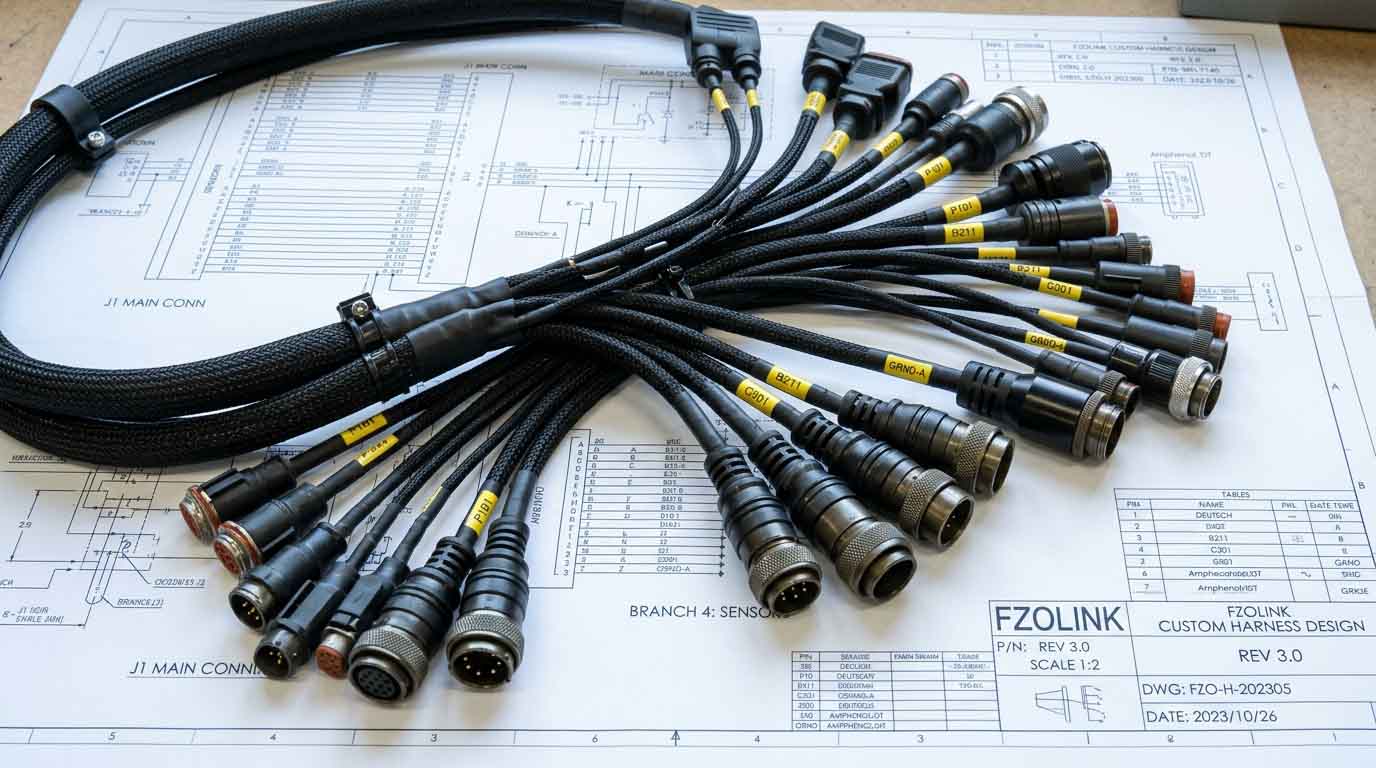
Modern industrial machinery—from multi-axis CNC machines and automated packaging lines to massive renewable energy inverters—is more complex than ever before. These machines rely on a dense nervous system of power distribution lines, digital fieldbus cables, and analog sensor wires. Historically, equipment builders relied on manual "point-to-point" wiring, cutting and routing individual wires during final assembly. Today, this outdated method is a liability. It consumes massive amounts of assembly time, invites human error, and creates maintenance nightmares. To achieve true scalability and operational reliability, top-tier Original Equipment Manufacturers (OEMs) are exclusively transitioning to professionally engineered custom wire harness assemblies. This article dissects the engineering advantages of consolidating industrial cabling.
In advanced automation, space is incredibly expensive. Control cabinets and machine enclosures are shrinking to minimize the physical footprint on the factory floor. When engineers attempt to route fifty independent cables through a confined chassis, the result is a tangled mass of wires that blocks cooling fans and creates dangerous thermal hotspots.
A custom wire harness solves this geometric puzzle. By bundling power and signal wires together using specialized corrugated tubing, heat-shrink sleeves, or nylon braiding, the overall volume of the cabling is reduced by up to 40%. This streamlined routing allows for unimpeded airflow across heat-generating components like Programmable Logic Controllers (PLCs) and variable frequency drives (VFDs). Furthermore, when these harnesses are precisely measured to integrate with industrial din-rail terminal blocks, the entire cabinet transforms from a chaotic web into a highly organized, thermally efficient power hub.
Cables routed through heavy machinery are constantly subjected to severe mechanical and environmental stress. In a robotic arm or a drag chain, continuous flexing will quickly fatigue and snap standard copper wiring. In outdoor applications, ultraviolet (UV) radiation and moisture will degrade standard PVC insulation, a challenge specifically addressed by ruggedized photovoltaic solar cable solutions.
Custom assemblies are engineered with their exact operating environment in mind. High-flex polyurethane (PUR) jackets are specified for continuous motion, while heavy-duty strain reliefs and overmolded boots prevent mechanical pull-out at the connector joints. Beyond mechanical defense, these harnesses incorporate braided tinned-copper shielding and twisted-pair layouts. This creates a highly effective Faraday cage, protecting delicate 5V sensor signals from the intense Electromagnetic Interference (EMI) generated by nearby high-voltage power lines and welding equipment.
The most significant hidden cost of point-to-point field wiring is human error. A single loose screw terminal, a poorly stripped wire, or an under-crimped contact can cause a catastrophic short circuit that destroys expensive control hardware upon startup.
Factory-built cable assemblies completely eliminate this variable. Before a custom harness ever leaves the manufacturing facility, it is subjected to rigorous, computerized quality control. Automated testing boards perform instantaneous pin-to-pin continuity checks to ensure zero miswiring. Mechanical pull-testers verify that every crimp exceeds international tensile strength standards. Finally, Dielectric Withstanding Voltage (Hi-Pot) testing forces high voltage through the assembly to guarantee that the insulation will not break down or arc under operational stress. The result is a 100% plug-and-play component that works perfectly the first time.
From a financial perspective, shifting the wiring burden from the OEM's assembly floor to a specialized harness manufacturer drastically reduces the Total Cost of Ownership (TCO). While purchasing a fully assembled harness carries a higher initial BOM (Bill of Materials) cost than buying spools of raw wire, the labor savings are exponential.
Instead of paying highly skilled electricians to spend ten hours measuring, cutting, stripping, crimping, and routing wires inside a machine, technicians can simply lay a pre-formed harness into the chassis and click the standardized connectors into place in less than thirty minutes. This rapid assembly significantly increases factory throughput, allowing OEMs to scale their production capacity without aggressively expanding their labor force.
| Production Phase | Manual Point-to-Point Field Wiring | Custom Wire Harness Assemblies |
|---|---|---|
| Machine Assembly Time | Extremely slow; requires hours of manual labor per unit. | Lightning-fast; plug-and-play installation in minutes. |
| Quality Control & Reliability | High risk of human error, miswiring, and inconsistent crimps. | Zero defects; 100% automated electrical and mechanical testing. |
| Space & Airflow | Chaotic routing consumes space and creates thermal hotspots. | Streamlined bundling maximizes chassis space and cooling. |
| Field Maintenance | Tracing individual wires for repair is highly complex and costly. | Modular design allows entire subsystems to be swapped instantly. |
OEMs prefer custom wire harnesses because they eliminate the chaos of point-to-point wiring by bundling all necessary power and signal cables into a single, space-saving assembly. This drastically reduces installation time, prevents miswiring, and improves airflow within control cabinets.
Engineered cable assemblies utilize braided tinned-copper shielding and twisted-pair configurations to create a Faraday cage around sensitive data lines. This protects critical sensor signals from Electromagnetic Interference (EMI) generated by nearby heavy machinery and motors.
High-quality manufacturers subject wire harnesses to rigorous automated testing, including pin-to-pin continuity checks, dielectric withstand (Hi-Pot) testing for insulation integrity, and mechanical pull-force testing to guarantee crimp strength.
Scaling your equipment production demands a supply chain partner you can trust. At Xiamen Olink, we specialize in the OEM/ODM manufacturing of high-complexity wire harnesses, robust industrial connectors, and advanced automated testing solutions. By engineering connectivity that perfectly matches your chassis dimensions and environmental requirements, we help you eliminate installation bottlenecks and ensure zero-defect reliability. Contact our engineering team today to prototype your next custom cable assembly.
Tel : 0592 6536915
Mobile : 8613950494073
Email : sophia@fzolink.com
Skype : Zheng lris
Whatsapp : 8613950494073