XIAMEN OLINK IMPORT & EXPORT CO.,LTD
Specially Develops, Produces and sells connectors / Terminals / wire harness / switches.


-
Give us a call 0592 6536915
-
Email us sophia@fzolink.com
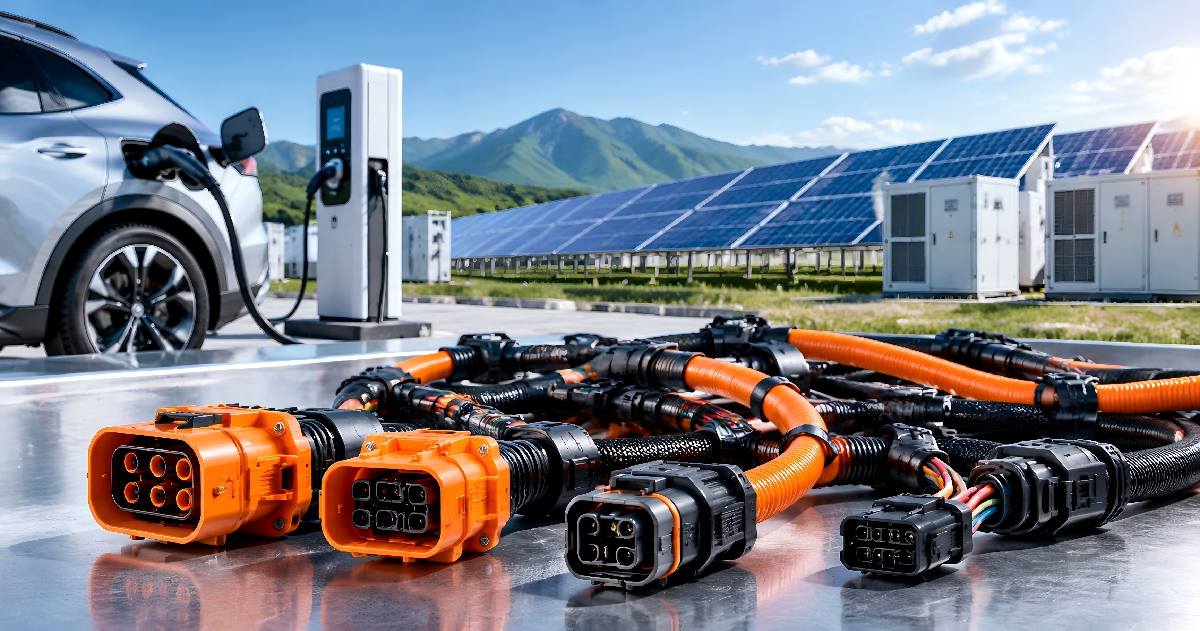
The global transition toward a low-carbon economy is accelerating at an unprecedented pace. At the forefront of this shift are two interconnected mega-trends: the mass adoption of Electric Vehicles (EVs) and the rapid expansion of renewable energy grids. While batteries, solar panels, and inverters often dominate the headlines, the invisible backbone making these technologies viable is the wire harness. A wire harness is far more than a bundle of cables; it is a highly engineered sub-system designed to route power and data safely under extreme conditions. Today, we will explore how advanced wire harness technology is solving the critical engineering bottlenecks in both the e-mobility and green energy sectors.
Unlike traditional internal combustion engine cars, electric vehicles operate on high-voltage electrical architectures (often 400V to 800V). This massive power requirement necessitates specialized high-voltage EV wire harnesses. These assemblies must safely carry heavy currents from the battery pack to the electric motor and the inverter without overheating.
EV harnesses require thick copper or lightweight aluminum conductors, heavily insulated with high-temperature resistant materials like silicone or cross-linked polyethylene (XLPE). Furthermore, because high-voltage switching generates intense electromagnetic interference (EMI), these harnesses must feature comprehensive braided metal shielding to protect sensitive onboard computers and autonomous driving sensors from signal corruption.
In the renewable energy sector, utility-scale solar farms and offshore wind turbines face brutal environmental conditions. Solar arrays are exposed to decades of relentless ultraviolet (UV) radiation, freezing nights, and extreme heat. The wire harnesses connecting individual solar panels to centralized inverters must offer uncompromising durability.
Manufacturers are developing specialized solar photovoltaic connectors and harness assemblies that carry IP68 waterproof ratings. These assemblies are engineered with UV-resistant sheathing and specialized sealing techniques to prevent moisture ingress, which can cause galvanic corrosion and catastrophic electrical short circuits in outdoor environments over their expected 25-year operational lifespan.
As demand for EVs and solar infrastructure skyrockets, wire harness manufacturers can no longer rely solely on manual labor. The future of harness assembly lies in automation. Advanced robotic machinery is now used for precision wire cutting, stripping, and terminal crimping. This automated approach ensures that every single connection meets strict mechanical pull-force and electrical conductivity standards.
Furthermore, high-tech manufacturing facilities now integrate automated optical inspection (AOI) and computerized continuity testing directly into the assembly line. This guarantees zero-defect manufacturing, which is absolutely critical when a single loose crimp could lead to a thermal runaway event in an EV battery pack.
| Engineering Factor | Electric Vehicles (EV) | Solar / Wind Energy |
|---|---|---|
| Primary Challenge | High voltage distribution, weight reduction, and spatial constraints. | Extreme weather exposure, UV degradation, and long cable runs. |
| Environmental Risks | Severe mechanical vibration, thermal shock, and road debris. | Direct sunlight (UV), heavy rain, snow, and salt-fog (offshore). |
| Shielding & Safety | Intense EMI shielding required for autonomous sensors. | High insulation resistance (XLPE) to prevent ground faults. |
| Connectors Used | High-current battery connectors, compact data sensor plugs. | IP68 waterproof branch connectors and robust utility junction boxes. |
Electric vehicles operate on high-voltage systems that require specialized wire harnesses to manage intense power loads, resist electromagnetic interference (EMI), and ensure structural integrity under constant physical vibration.
Solar wire harnesses utilize cross-linked polyethylene (XLPE) insulation and high-grade copper or aluminum conductors to resist UV radiation, extreme temperature fluctuations, and moisture ingress over a 25-year lifespan.
Automated cutting, stripping, and crimping eliminate human error, ensuring consistent terminal retention force, exact wire lengths, and reliable electrical conductivity across high-volume production runs.
At Xiamen Olink, we understand that reliability is the cornerstone of the green energy revolution. We engineer and manufacture custom wire harness solutions designed to meet the rigorous demands of electric vehicles, battery energy storage systems (BESS), and solar photovoltaic arrays. Contact our engineering team today to learn how our certified connectivity solutions can power your next industrial project.
Tel : 0592 6536915
Mobile : 8613950494073
Email : sophia@fzolink.com
Skype : Zheng lris
Whatsapp : 8613950494073